


Most vendor finance programs are built to process paper, not to sell equipment — and that single design flaw is the difference between a financing option nobody uses and a program that closes deals.
Nearly nine in ten businesses that acquire equipment now use some form of financing to do it, according to the Equipment Leasing & Finance Foundation’s 2024 Industry Horizon Report. Financing at the point of sale isn’t a value-added extra anymore — it’s the baseline expectation. Yet most OEMs and distributors still treat their vendor finance program as an administrative afterthought: a rate sheet handed to a lender, not a sales tool engineered for conversion.
That’s the single biggest mistake in vendor finance design, and it’s costly. Vendors with an integrated, well-designed financing program report roughly 20% higher sales and nearly 25% greater profit than those without one, per a Siemens Financial Services study.
Design around how buyers actually decide to finance
Buyers finance equipment for three concrete reasons: 62% to optimize cash flow, 55% to protect against equipment obsolescence, and 51% for tax advantages, according to the ELFF, 2024. A program built around one generic FMV lease product answers none of those particularly well.
A program that pairs cash-flow-optimized structures, upgrade/trade paths, and tax-aware terms — offered at the point of quote — answers all three.
Price discounting vs. finance subvention: know the difference
Here’s the sales-psychology trap that quietly drains margin. When financing isn’t built into the conversation, reps default to the one lever they always control — cutting the machine’s price to close an indecisive buyer. Every dollar of that discount comes straight off gross margin, and it comes off permanently. A $2 million machine discounted 5% surrenders $100,000 of margin forever.
Finance subvention is a different tool entirely. The OEM pays the lender a defined buy-down fee to lower the customer’s rate — the customer sees a smaller payment, but the machine’s sticker price and margin stay intact. An un-integrated program forces reps to sell on price. An integrated one lets them sell on monthly cash-flow utility instead — and a targeted subvention buy-down protects margin a price cut would surrender outright, per Monitor Daily.
Track attachment rate and wallet share like sales metrics
Industry-leading finance-attachment rates run above 40%, and top performers capture over 70% of a vendor’s total financing wallet share once a program is deeply integrated, according to Secured Research’s 2025 Vendor Finance Performance Index, cited by Suite by Monitor. A program that isn’t measured this way is being run as a compliance function, not a revenue function.
Don’t let a single bank’s risk appetite become your financing availability
Bank willingness to lend swings independently of OEM sales cycles. The Federal Reserve’s Senior Loan Officer Opinion Survey shows the net share of banks tightening standards on commercial & industrial loans swung nearly 10 points in just four quarters. A vendor program anchored to one bank inherits that volatility directly. Purpose-built funding tranches don’t, according to Federal Reserve / FRED data.
What this looks like in practice
In 16 years building OEM captive and vendor finance programs, the pattern was always the same: manufacturers signed a financing partner, put a rate sheet in the sales binder, and wondered six months later why attachment rates stayed flat. The rate was never the problem — the design was.
At EFG, that discipline shows up directly in the numbers: $750M+ financed, a 92% approval rate, a 67% repeat-customer rate, and a $2.1M average deal size.
Consider a mid-market plastics OEM selling a $2M extrusion line: financed at the point of quote with same-week approval, that deal closes at full price. Routed through a generic bank portal with a two-week turnaround, the rep cuts the machine price to hold the deal — surrendering margin a rate buy-down would have preserved.
Talk to EFG about what a vendor finance program built for your sales motion — not your funding partner’s back office — actually looks like.
Sources
- Equipment Leasing & Finance Foundation, 2024 Industry Horizon Report
- Siemens Financial Services, “How Smart Financing Programs Enable Sales & Profit”
- Monitor Daily, “Impact of Economic Uncertainty on Vendor Equipment Finance Strategy”
- Suite by Monitor, “The Vendor Finance Multiplier”
- Federal Reserve / FRED, “Net Percentage of Domestic Banks Tightening Standards for C&I Loans”

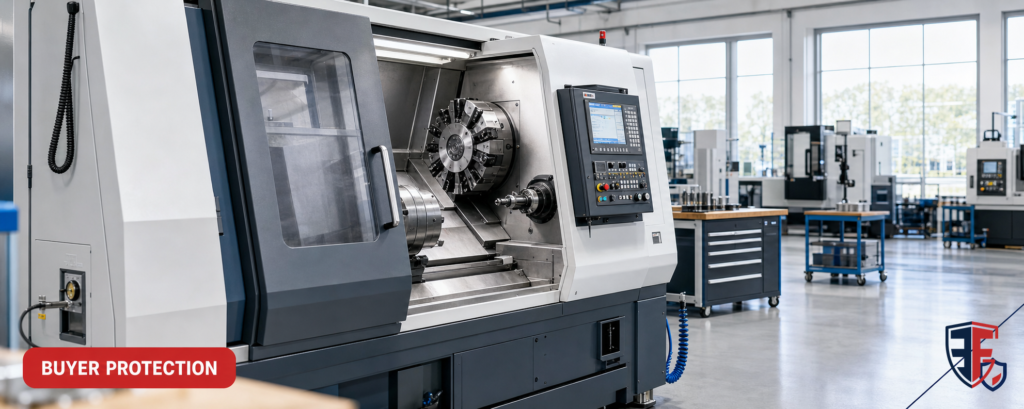
A $2 million CNC machining center is worth what someone will pay for it in a forced sale eighteen months from now — not what the OEM’s price sheet says today. Most bank underwriting never asks that question.
U.S. manufacturing technology orders hit $5.74 billion in 2025, up 22.5% over 2024, with December setting an all-time monthly record at $814.3 million, according to AMT/USMTO. Robot orders grew 6.6% the same year, with demand broadening well beyond automotive, according to A3, via Yahoo Finance. Behind that growth sits a financing question most buyers never think to ask: is the lender pricing the actual machine, or just running a generic credit model against the balance sheet?
That distinction is asset-based underwriting, and it matters more for machine tools and automation than for almost any other equipment category.
Why the collateral description is the real risk on automation
A CNC lathe, a five-axis machining center, and a robotic welding cell each depreciate differently and cost different amounts to remove and remarket. But the deeper, less-appreciated risk on integrated automation is that the collateral does not stay still.
An integrated cell financed as one unit — a six-axis robot, a controller, an end-of-arm tool, a fixture, and guarding — can be re-tasked by a plant engineer in an afternoon. The robot is unbolted and moved to another line, the controller is re-flashed, the tooling is swapped. Reconfiguration is an operational routine, not a default event — which is exactly why it is dangerous for the lender.
Under UCC Article 9, a security interest must reasonably identify its collateral, and a description tied to a single assembled configuration can leave a lender unable to prove which physical components its lien actually attaches to after the cell is componentized and spread across a plant, per Cornell Law School LII, UCC § 9-108.
The fix is discipline, not luck: identify each major component by manufacturer serial number, anticipate relocation and re-tasking in the collateral description, and reconcile the cell at each field review. Collateral monitoring for automation has to verify not just that the equipment exists, but that each financed component is still identifiable and still traceable to the filing. Technology helps with visibility, but as SFNet notes, real-time data still “requires judgment.”
The four mechanics of asset-based underwriting
- Asset-specific valuation, not book depreciation — pricing the actual make, model, and controls package against real secondary-market data.
- Collateral monitoring built for an integrated cell — component-level, serial-numbered descriptions that survive reconfiguration.
- Legal structuring around the collateral — correct UCC Article 9 perfection and default procedures, which differ by asset type, per Cornell Law LII.
- Tax-aware structuring — for 2026, up to $2,560,000 in qualifying equipment can be expensed under Section 179, phasing out above $4,090,000, per IRS Publication 946.
Bank credit boxes move with the cycle, not your collateral
The macro backdrop makes a bank-only relationship riskier. The Fed’s April 2026 Senior Loan Officer Opinion Survey found banks tightening C&I standards and collateralization across firms of all sizes, and St. Louis Fed data shows the net share of large banks tightening those standards swung from -5.3 to 10.0 in a single quarter of 2026, per FRED. Your CNC line did not change — your bank’s risk appetite did.
The takeaway
A mid-market plastics OEM buying a $2 million CNC line does not need a lender guessing at residual value from a spreadsheet. It needs a partner who has remarketed that class of machine before and prices the deal accordingly from day one. EFG has financed more than $750 million in industrial and manufacturing equipment on exactly this model, with a 92% approval rate and a 67% repeat-customer rate.
Talk to EFG before your next machine tool or automation purchase. As an advocate, not a bank, EFG structures the deal around what the equipment is actually worth — and writes the collateral description to survive how the equipment actually gets used. Talk to EFG.
Sources: AMT/USMTO · A3 robot orders · Federal Reserve SLOOS · FRED C&I tightening · Cornell Law LII, UCC § 9-108 · SFNet, Built-In Discipline · IRS Publication 946.

Financing isn’t an accessory to the equipment sale. For most buyers, it is the sale — and the OEM that can answer the financing question at the point of sale wins deals the OEM that refers it out loses.
The U.S. equipment finance industry reached an estimated $1.34 trillion in 2023, with 82% of end-users financing their acquisitions, according to the Equipment Leasing & Finance Foundation’s 2024 Horizon Report. This is not a uniquely American pattern: roughly 40% of Canadian machinery and equipment purchases are financed through the asset-based finance industry, per the Canadian Finance & Leasing Association, and vendors originate around 35% of European lease distribution, according to Leaseurope. Manufacturers who can answer the financing question at the point of sale hold a structural advantage on every continent that tracks it.
What is captive finance?
A captive is a financing arm owned by, or operated on behalf of, an equipment manufacturer to fund its customers’ purchases. It uses deep knowledge of the manufacturer’s own equipment and residual values as underwriting leverage. That is why captives have historically posted the highest approval rates of any lender category — the Equipment Leasing & Finance Foundation found captives averaging in the 90% range across the period it reviewed, and recent ELFA CapEx Finance Index data shows captive approval rates still running above banks and independents.
Why can’t most mid-market OEMs just build one?
Building a true captive is a multi-year, capital-intensive undertaking. Roland Berger puts the threshold at roughly €75 million in annual financing volume before a standalone captive is economically justified, plus a leasing or banking license before an OEM can fund sales directly. The ELFA Foundation describes captives as standalone organizations requiring an expensive investment in resources and infrastructure most parent companies cannot replicate internally.
What does referring the deal to a bank cost?
Referring a buyer to an unaligned bank hands away control of approval speed, pricing, and the customer relationship — and stalls the sale in a queue the OEM cannot see into. The exact cost of that lag varies by lender and deal, so treat it directionally rather than as a fixed number: every additional day a financeable buyer waits on an outside lender is a day a competitor with an embedded financing answer can win the account.
McKinsey & Company found that buyers would purchase roughly four times as much directly from suppliers if financing were seamlessly available at checkout, and that embedded-finance volumes in Europe have grown three times faster than directly distributed lending over the past decade.
The third option: an outsourced, or “virtual,” captive
There is a middle path between building a regulated lender and referring deals out. In a virtual captive, a finance partner supplies the capital, underwriting infrastructure, and servicing, while the OEM’s brand stays in front of the customer. The National Equipment Finance Association describes it as an alliance with a third-party lessor that provides underwriting and capital while the manufacturer’s brand and sales relationship stay intact. The OEM keeps the brand, the customer data, and credit-policy say-so, while offloading the balance-sheet risk and back-office burden that make in-house captives so expensive.
What this looks like in practice
I built a captive program for Makino, a machine tool builder, starting in 2001, and spent 16 years building OEM captive and vendor programs before founding EFG in 2010. The recurring lesson: most mid-market manufacturers needed what a captive delivers, but had no realistic path to building one.
EFG runs the outsourced version — more than $750 million financed, a 92% approval rate, a 67% repeat-customer rate, and a $2.1 million average deal size, according to Equipment Finance Group.
Talk to EFG about whether an outsourced captive fits your customer base and equipment mix — before the next deal is lost to a competitor with an answer already in hand.
Sources
- Equipment Leasing & Finance Foundation, “2024 Horizon Report”
- Canadian Finance & Leasing Association, submission to the House of Commons Standing Committee on Finance
- Leaseurope, response to the European Banking Authority consultation on the Credit Risk Framework
- Equipment Leasing & Finance Foundation, “Captive Finance Firms in a Challenging Economy”
- Equipment Leasing & Finance Association, “CapEx Finance Index: November 2025”
- Roland Berger, “Captive Finance: A Multipurpose Strategic Tool for Manufacturers”
- McKinsey & Company, “Embedded Finance in Europe: Converging Platforms”
- National Equipment Finance Association, “Vendor Programs”
- Equipment Finance Group

Your bank underwrites your CNC line the same way it underwrites your business line of credit — as a bet on your balance sheet, not on the machine. That is exactly why good deals for good manufacturers are getting slow-walked or declined right now.

Banks are still the largest single source of equipment financing in the U.S. But their share of new business volume fell 1.3% in 2024 even as captives grew 5.9% and independents grew 17.7%, a shift the Equipment Leasing & Finance Association attributes to tightening credit, not weak demand. Demand is actually strong: January 2026 posted the largest one-month dollar increase in the ELFA CapEx Finance Index‘s two-decade history, driven largely by manufacturers.
So why are good manufacturers getting slow-walked? The answer is structural, and it comes down to how bank equipment credit is actually decided.
How a relationship credit model arbitrarily limits machine shop capacity
Roughly three-quarters of bank equipment financing volume goes to the bank’s own existing relationship customers, per the Equipment Leasing & Finance Foundation‘s Horizon Report. Bank equipment credit is a function of the deposit and treasury relationship, not a standalone view of the asset.
Bank capital requirements are also explicitly risk-sensitive — a source of pro-cyclicality the Federal Reserve has documented. Capital charges rise as perceived risk rises, pushing banks to pull back exactly when borrowers need capital most. Layer on concentration management — banks treat concentration as a monitored risk category, per Moody’s — and a profitable machine shop can lose access to a $2 million press it never mispriced. The constraint is the bank’s book, not the shop’s capacity.
The Fed’s April 2026 Senior Loan Officer Opinion Survey found banks tightening standards and collateral terms across firms of all sizes, citing macro uncertainty — not borrower-specific deterioration.
The specialist starts from the machine
Specialty and captive lenders start from the collateral. The Fed’s Small Business Credit Survey shows non-bank finance companies posting the highest approval rate of any lender type — 76%, versus 66% for large banks, per the Federal Reserve. That gap comes largely from a higher share of secured, asset-based lending.
| Lender Type | Approval Outcome |
|---|---|
| Non-bank finance companies | 76% approved for at least some financing |
| Large banks | 66% approved for at least some financing |
| EFG (company-reported) | 92% approval rate, collateral-first underwriting |
Consider a common, anonymized pattern: a mid-market plastics OEM needs a $2 million CNC and automation line. The bank’s equipment desk routes the request through the same committee reviewing the company’s revolving line, real estate debt, and cash management — as one combined exposure — and asks for four to six weeks. A specialty lender underwriting the same request starts from resale value, useful life, remarketing data on that model, and the cash flow the equipment will generate. That deal funds in days. The manufacturer is not a worse credit; the underwriting question is simply narrower and better matched to what is being financed.
Lien scope is a choice, not a legal requirement
Under UCC Article 9, a lender can file broadly against a business’s entire asset base or narrowly against only the equipment financed — a purchase-money security interest limited to that asset, per Cornell Law School LII and Cummings & Cummings Law. A relationship-banking lender has less incentive to limit its lien than a lender whose entire business is that one piece of equipment.
Capital is reorganizing around the asset
This is not just an equipment-finance story. McKinsey & Company estimates $5–6 trillion in bank-balance-sheet assets could migrate to non-bank, asset-based lenders over the next decade, with asset-based finance’s share of private credit fundraising already up from 10.6% to 16.4% year-over-year. The pattern holds abroad, too: Canada’s asset-based finance sector grew 6.4% to $120 billion in 2023, per CFLA.
The takeaway
None of this means banks are wrong for every deal. But bank equipment credit is built on enterprise-wide relationship and capital dynamics that can tighten abruptly and uniformly, independent of any one manufacturer’s equipment or cash flow. If you are financing specialized, collateral-intensive equipment, you increasingly need a lender that starts from the machine and the deal.
EFG’s role, as an advocacy captive, is to help OEMs and equipment buyers see the full set of options clearly — bank, captive, or independent — and structure financing that fits the equipment, the timeline, and the business. If you are evaluating financing for a CNC line, a molding press, or an automation cell, that conversation costs nothing and commits you to nothing. Talk to EFG.
Sources: ELFA 2025 SEFA · ELFA CapEx Finance Index, Jan. 2026 · Equipment Leasing & Finance Foundation, Horizon Report · Federal Reserve SLOOS, April 2026 · Federal Reserve, Consumer & Community Context · Moody’s, Concentration Risk · Cornell Law LII, UCC § 9-108 · McKinsey, Private Credit · CFLA Canadian Market Overview.

By Chris Lyle, Founder & CEO, Equipment Finance Group
Your bank can file one piece of paper today that quietly puts your receivables, your inventory, your deposit accounts, and every machine on your shop floor — including ones you haven’t bought yet — behind a single loan you took out to buy one CNC mill.
(Educational only — not legal advice.)
A blanket lien doesn’t describe collateral — it describes everything a business owns, present and future, in a single filing. Article 9 of the Uniform Commercial Code expressly permits a security interest “over the assets of an entire entity rather than an individual asset,” and that’s exactly what most bank equipment loans use, per the Cornell Law School Legal Information Institute. Federal Reserve survey data shows how common this has become: among firms carrying business debt, 51% have pledged business assets as collateral and 59% have signed a personal guarantee, per the Federal Reserve, 2026 Report on Employer Firms.
It reaches beyond the asset. A UCC-1 filing is public record and stays active for five years unless renewed. It doesn’t self-terminate when the debt is paid off — a UCC-3 termination statement has to be filed, and that doesn’t always happen automatically, per UCC § 9-515.
It attaches to what you buy next. Thanks to an “after-acquired property” clause, a blanket lien can automatically encumber equipment you buy years later — before you’ve even negotiated terms on the new purchase, per UCC § 9-204.
There’s a legal alternative most buyers never ask for. A specialist lender scopes its security interest to the specific asset — often perfected as a purchase-money security interest (PMSI). Read the timing rule carefully: when properly perfected within 20 days of the debtor taking possession, a UCC § 9-324 Purchase-Money Security Interest has priority over an earlier, broader lien on the same collateral, per UCC § 9-324. Miss that 20-day window and the super-priority is lost. The law already favors scoped collateral — most buyers just never ask for it.
Consider a composite pattern: a $1.8M CNC production cell financed through a bank, secured by a blanket UCC-1 covering “all assets… now owned or hereafter acquired.” Two years later the company needs a modest working-capital increase for a new contract — and the bank declines, not because the numbers don’t work, but because its own blanket lien already treats every asset as committed. Collateral scoped to the equipment would never have entered that decision.
Neutral risk data backs the scoped approach. The Secured Finance Network, writing to federal regulators, argues well-understood, monitored asset-based collateral produces first-lien recovery rates near 100% after default — better than the 70–80% typical of general first-lien debt, per the SFNet letter, August 2025.
Your Contract Negotiation Checklist
- Demand a PMSI scoped to the machine — make, model, serial number.
- Confirm perfection inside the 20-day window so § 9-324 super-priority attaches.
- Reject “all assets, now owned or hereafter acquired.”
- Delete the after-acquired property clause.
- Get the UCC-3 termination commitment in writing at payoff.
- Search existing filings first so a stale lien doesn’t subordinate the new deal.
Ask the Question Before You Sign
Does your next equipment loan secure the machine, or everything else you own too? The answer is sitting in the collateral description of the UCC-1 filing. Talk to EFG before you sign — we’ll review the proposed collateral scope on your next equipment purchase, at no cost and no obligation, as an advocate for your balance sheet.

By Chris Lyle, Founder & CEO, Equipment Finance Group
Your bank can shut down your next expansion without ever saying no to your equipment loan — it just quietly attaches a lien to everything else you own first.
A national bank’s loans to any single borrower are capped by law at 15% of its capital and surplus — 25% if fully secured — under 12 CFR § 32.3 and guidance from the Office of the Comptroller of the Currency. That ceiling exists to protect the bank, not to fund your CNC mill or injection press. Yet most manufacturers still walk into their relationship bank first when it’s time to finance a $1–3 million machine.
The mismatch is structural, not personal. Banks are balance-sheet institutions built around deposits, fee income, and real estate — commercial real estate exposure alone ran at 369% of Tier 1 capital industry-wide in mid-2025, per Risk.net. Equipment simply isn’t where a bank’s credit committee spends its attention. The Federal Reserve‘s 2026 Report on Employer Firms shows 59% of firms with business debt have signed a personal guarantee and 51% have pledged business assets — evidence that banks routinely reach beyond the asset being financed.
Where the money actually goes. A specialist lender’s collateral is the equipment — a specific make, model, and serial number with a known resale market. A bank often files a blanket UCC-1 covering “all assets,” a structure Article 9 expressly permits, per the Cornell Law School Legal Information Institute. Consider a composite pattern: a $1.5M fabrication line financed through a bank that files an all-assets lien; eighteen months later the company needs a modest working-capital increase, and the credit committee declines — not because cash flow doesn’t support it, but because its own blanket lien already treats every asset as fully committed.
Your Contract Negotiation Checklist. Before you sign your next equipment facility, treat the term sheet as something you negotiate:
- Demand a purchase-money carve-out scoped to the specific machine.
- Reject any “all-assets, now owned or hereafter acquired” description.
- Kill the after-acquired property clause so your next purchase stays free.
- Cap the personal guarantee — or remove it.
- Confirm the UCC-3 termination trigger in writing at payoff.
- Ask what borrowing capacity this loan consumes.
(Educational and general in nature — not legal advice. Have counsel review your specific documents.)
Why this pattern keeps repeating. As a CFO and, later, building OEM captive programs for 16 years before founding EFG in 2010, I watched the same thing over and over: the equipment was never the risk the bank was actually pricing — the bank was pricing its own balance sheet. EFG operates as an “advocacy captive,” financing only the categories we understand — CNC, injection molding, robotics, automation — with collateral scoped to the machine. We’ve financed more than $750 million with a 92% approval rate and a 67% repeat-customer rate, per Equipment Finance Group. This tracks a broader shift: McKinsey estimates trillions of dollars migrating from bank balance sheets to nonbank lenders over the next decade.
Ask the Question Before You Sign
None of this means your bank is a bad partner for deposits, treasury, and real estate. But equipment is a side product to a bank and a core competency to a specialist. Before your next purchase, ask one question: is this loan secured by the machine, or by everything else you own? Talk to EFG — we’ll review your terms, structure, and collateral exposure before you sign, with no obligation.

By Chris Lyle, Founder & CEO, Equipment Finance Group
If you’re an OEM, here’s a hard truth: the finance partner with the lowest rate is rarely the one who sells the most of your equipment.

Roland Berger puts it bluntly — OEMs and specialist partners have “superior asset know-how and a unique ability to manage residual value, allowing them to offer much more competitive prices than traditional financial institutions.” Expertise is where the better price comes from.
Why asset expertise beats rate
The numbers make the case. In the ELFA Foundation’s captive study, captives approved 91–92% of applications versus 72% industry-wide and carried residuals 74% higher than the industry, per the ELFA Foundation captive finance study.
Those are 2009-vintage benchmarks, but they remain the most rigorous quantified comparison available. Deep product knowledge translates into more approvals and better residuals — which means more units sold.
The OEM trust triangle
Trust with a manufacturer rests on three legs:
- Asset expertise. Can the partner discuss your equipment’s specific residual curve and secondary market, not generic terms, per Roland Berger?
- Market and cycle expertise. Do they understand your demand seasonality and how to keep lending when credit tightens? In 2024, captive new business volume grew 5.9% while bank volume fell 1.3%, per the ELFA 2025 SEFA news release.
- Structural alignment. Are they honest about whether you need a referral, a vendor program, or a captive?
Captive vs. vendor program: which fits your scale?
The models differ on who owns the portfolio. A captive is owned by the parent and carries an on-balance-sheet portfolio; a vendor finance program is aligned to the brand but a third party owns the portfolio, per the ELFA Foundation captive finance study and PNC Insights.
Scale decides. Below roughly EUR 75 million in annual financing volume, a white-label vendor program delivers a branded experience without the balance-sheet burden of a captive, per Roland Berger. You capture the trust benefits without becoming a bank.
ASC 842 changed the math
The old off-balance-sheet advantage is gone. Under ASC 842 and IFRS 16, virtually all leases now appear on the balance sheet, which changes the case for captive, vendor-program, and referral models, per Visual Lease and Roland Berger.
That’s why expertise, not accounting tricks, is now the differentiator.
The questions that reveal real expertise
Ask about residuals, secondary markets, and integration — not rate. Only 40% of captive and vendor programs actively integrate asset and pricing systems with parent inventory, and 71% describe their integration as “limited,” so the expertise story must be backed by real systems, per the ELFA Foundation captive finance study.
And expertise travels. Captives could finance non-parent-branded equipment in 76% of cases, so one trusted partner can grow across your entire product line, per the ELFA Foundation captive finance study.
The takeaway is simple. Choose the partner who knows your equipment well enough to become part of your sales process — and match the structure to your scale.
Educational only; not legal, tax, or accounting advice. Lease classification, revenue recognition, UCC-9 perfection, and captive vs. vendor structuring are fact-specific and vary between IFRS and U.S. GAAP — confirm with qualified counsel and your accountant. ELFA Foundation benchmarks cited are 2009-vintage. Named vendors illustrate market patterns, not authorities. No EFG client outcomes are claimed.
Sources: Roland Berger · ELFA Foundation captive finance study · PNC Insights · ELFA 2025 SEFA news release · Visual Lease · OCC Comptroller’s Handbook · Cornell Legal Information Institute


By Chris Lyle, Founder & CEO, Equipment Finance Group
Ask a CFO how they pick an equipment finance partner and the honest answer has changed. It’s no longer “whoever’s cheapest.”
In a $1.34 trillion U.S. industry, 82% of end-users financed equipment or software in 2023, so financing is a mainstream capital decision CFOs actively manage, per the Equipment Leasing & Finance Foundation. The real question is whether they can trust the partner.
Why rate stopped being the deciding factor
Survey data is blunt about it. Among middle-market finance leaders, 93% wanted to hear what makes a finance company different and 83% would pay more for perceived relationship value, while lenders leading with rate alone were “poorly regarded,” per LTi Technology Solutions.
Credit is also tightening. Dollar-based approval rates fell from 67.5% in 2023 to 61.8% in 2024, which raises the value of a partner who can still say “yes” with discipline, per the Equipment Leasing & Finance Association.
The 5 trust tests CFOs should apply
- Transparency. Does the partner disclose full total cost — rate, UCC filing fees, late fees, residual terms — before you ask? Total cost is not the same as the headline rate, per the Equipment Loans Guide.
- Structuring. Can they flex across loan, lease, and seasonal structures and explain the balance-sheet impact of each? Under ASC 842, nearly all leases now create a right-of-use asset and a lease liability, so the “off-balance-sheet lease” pitch is dead, per Visual Lease.
- Speed. Is their decision timeline realistic against a market where approval sat at 78.1% in December 2025, per the ELFA CapEx Finance Index?
- Expertise. Do they show real asset-class fluency — residual value, secondary market — rather than generic terms, per the Equipment Loans Guide?
- Durability. Can they survive a cycle? With industry ROA at 1.1% and ROE at 7.9% in 2024, check track record and ELFA/NEFA membership, per the Equipment Leasing & Finance Association.
Bank, captive, or independent — they don’t behave the same
The partner type matters. In 2024, bank new business volume fell 1.3% while captives grew 5.9% and independents grew 17.7%, reflecting different risk appetites as credit tightened, per the Equipment Leasing & Finance Association.
Regulation differs too. National-bank lessors must generally structure full-payout, net leases with residual value capped at 25% of original cost, a constraint non-bank finance companies don’t share, per the OCC Comptroller’s Handbook.
Don’t forget the tax structure
Structure drives after-tax cost. For 2026 the Section 179 cap rises to $2,560,000 with phase-out starting at $4,090,000 under the OBBBA, and bonus depreciation was restored to 100% for qualifying property, per Section179.org and Instead.com. A good partner models this with you and points you to your own tax advisor.
The takeaway is simple. Compare the total structure, not just the number — and choose a partner who behaves like an extension of your treasury.
Educational only; not legal, tax, or accounting advice. Total cost, lease classification, UCC perfection, and tax eligibility are fact-specific and vary — confirm with qualified counsel and your accountant. Named vendors illustrate market patterns, not authorities. No EFG client outcomes are claimed.
Sources: ELFA 2025 SEFA · ELFA Foundation Horizon Report · ELFA CapEx Finance Index · LTi Technology Solutions · Equipment Loans Guide · Visual Lease · OCC Comptroller’s Handbook · Section179.org · Instead.com