

A $2 million CNC machining center is worth what someone will pay for it in a forced sale eighteen months from now — not what the OEM’s price sheet says today. Most bank underwriting never asks that question.
U.S. manufacturing technology orders hit $5.74 billion in 2025, up 22.5% over 2024, with December setting an all-time monthly record at $814.3 million, according to AMT/USMTO. Robot orders grew 6.6% the same year, with demand broadening well beyond automotive, according to A3, via Yahoo Finance. Behind that growth sits a financing question most buyers never think to ask: is the lender pricing the actual machine, or just running a generic credit model against the balance sheet?
That distinction is asset-based underwriting, and it matters more for machine tools and automation than for almost any other equipment category.
Why the collateral description is the real risk on automation
A CNC lathe, a five-axis machining center, and a robotic welding cell each depreciate differently and cost different amounts to remove and remarket. But the deeper, less-appreciated risk on integrated automation is that the collateral does not stay still.
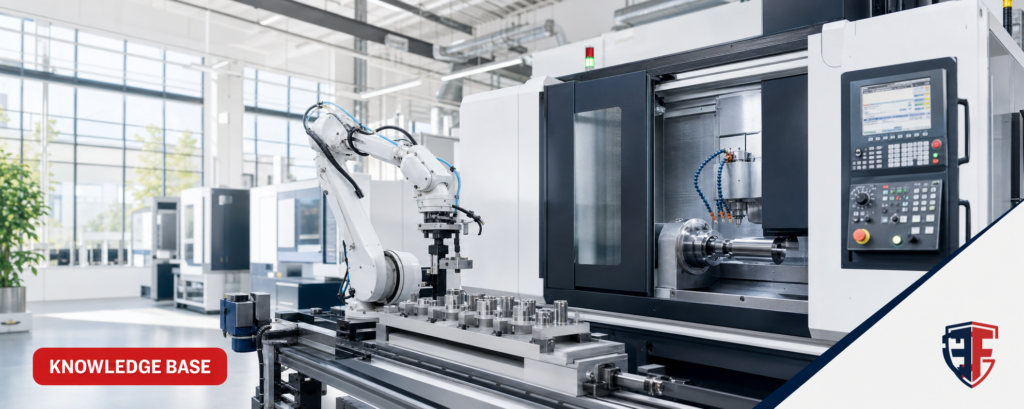
An integrated cell financed as one unit — a six-axis robot, a controller, an end-of-arm tool, a fixture, and guarding — can be re-tasked by a plant engineer in an afternoon. The robot is unbolted and moved to another line, the controller is re-flashed, the tooling is swapped. Reconfiguration is an operational routine, not a default event — which is exactly why it is dangerous for the lender.
Under UCC Article 9, a security interest must reasonably identify its collateral, and a description tied to a single assembled configuration can leave a lender unable to prove which physical components its lien actually attaches to after the cell is componentized and spread across a plant, per Cornell Law School LII, UCC § 9-108.
The fix is discipline, not luck: identify each major component by manufacturer serial number, anticipate relocation and re-tasking in the collateral description, and reconcile the cell at each field review. Collateral monitoring for automation has to verify not just that the equipment exists, but that each financed component is still identifiable and still traceable to the filing. Technology helps with visibility, but as SFNet notes, real-time data still “requires judgment.”
The four mechanics of asset-based underwriting
- Asset-specific valuation, not book depreciation — pricing the actual make, model, and controls package against real secondary-market data.
- Collateral monitoring built for an integrated cell — component-level, serial-numbered descriptions that survive reconfiguration.
- Legal structuring around the collateral — correct UCC Article 9 perfection and default procedures, which differ by asset type, per Cornell Law LII.
- Tax-aware structuring — for 2026, up to $2,560,000 in qualifying equipment can be expensed under Section 179, phasing out above $4,090,000, per IRS Publication 946.
Bank credit boxes move with the cycle, not your collateral
The macro backdrop makes a bank-only relationship riskier. The Fed’s April 2026 Senior Loan Officer Opinion Survey found banks tightening C&I standards and collateralization across firms of all sizes, and St. Louis Fed data shows the net share of large banks tightening those standards swung from -5.3 to 10.0 in a single quarter of 2026, per FRED. Your CNC line did not change — your bank’s risk appetite did.
The takeaway
A mid-market plastics OEM buying a $2 million CNC line does not need a lender guessing at residual value from a spreadsheet. It needs a partner who has remarketed that class of machine before and prices the deal accordingly from day one. EFG has financed more than $750 million in industrial and manufacturing equipment on exactly this model, with a 92% approval rate and a 67% repeat-customer rate.
Talk to EFG before your next machine tool or automation purchase. As an advocate, not a bank, EFG structures the deal around what the equipment is actually worth — and writes the collateral description to survive how the equipment actually gets used. Talk to EFG.
Sources: AMT/USMTO · A3 robot orders · Federal Reserve SLOOS · FRED C&I tightening · Cornell Law LII, UCC § 9-108 · SFNet, Built-In Discipline · IRS Publication 946.
